Five Elements Reference Table Trilingual
Five Elements: the five basic elements that constitute the human body.
| Element | Characteristics | Functions | Three Humors Relationship | Medicinal Relevance |
|---|---|---|---|---|
| 土 ས་<br/>Earth | Heavy, stable, dull, soft, moist, dry | Provides solidity, support, and stability. Forms bones, muscles, firm tissues. | Phlegm's fluid regulation — Earth's moist quality. | Earth is the source of growth for medicinal plants. |
| 水 ཆུ་<br/>Water | Wet, moist, soft, heavy, cold, thin | Moistens, binds, and coalesces. Forms blood, saliva, and bodily fluids. | Phlegm's fluid regulation — Water's moist quality. | Water is the vital juice for medicinal plant growth. |
| 火 མེ་<br/>Fire | Hot, sharp, light, mobile, coarse, dry | Warms, matures, and transforms. Generates body heat and digestive fire. | Bile's heat production — Fire's hot quality. | Fire is the heat source for medicinal plant growth. |
| 风 རླུང་<br/>Wind | Light, mobile, cold, coarse, astringent, dry | Moves, breathes, and pervades. Forms gases and energy, drives all movement. | Wind's propelling function — Wind's moving quality. | Wind is the motive force for medicinal plant circulation. |
| 空 ནམ་མཁའ་<br/>Space | Empty, open, unobstructed | Provides room and possibility. Forms internal cavities and orifices within the body. | Wind's field — Space quality. | Space is the open ground for medicinal plant growth. |
Notes
When the five sources in the body are balanced (neither increased, decreased, nor disturbed), there is health. When they are imbalanced, there is disease. — From the Four Medical Tantras (rGyud-bzhi)
Five Elements → Three Humors Flowchart
Mutual interaction and dynamic balance
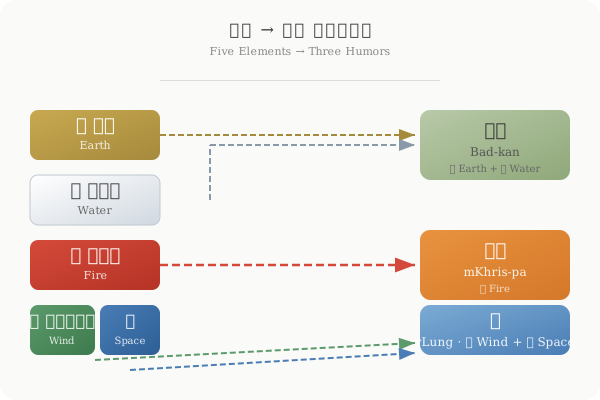
Three Factors & Five Elements
| rLung | mKhris-pa | Bad-kan |
|---|---|---|
| Wind | Fire | Earth |
| Space | Water |
The Color Code of Medical Thangkas (Manthang)
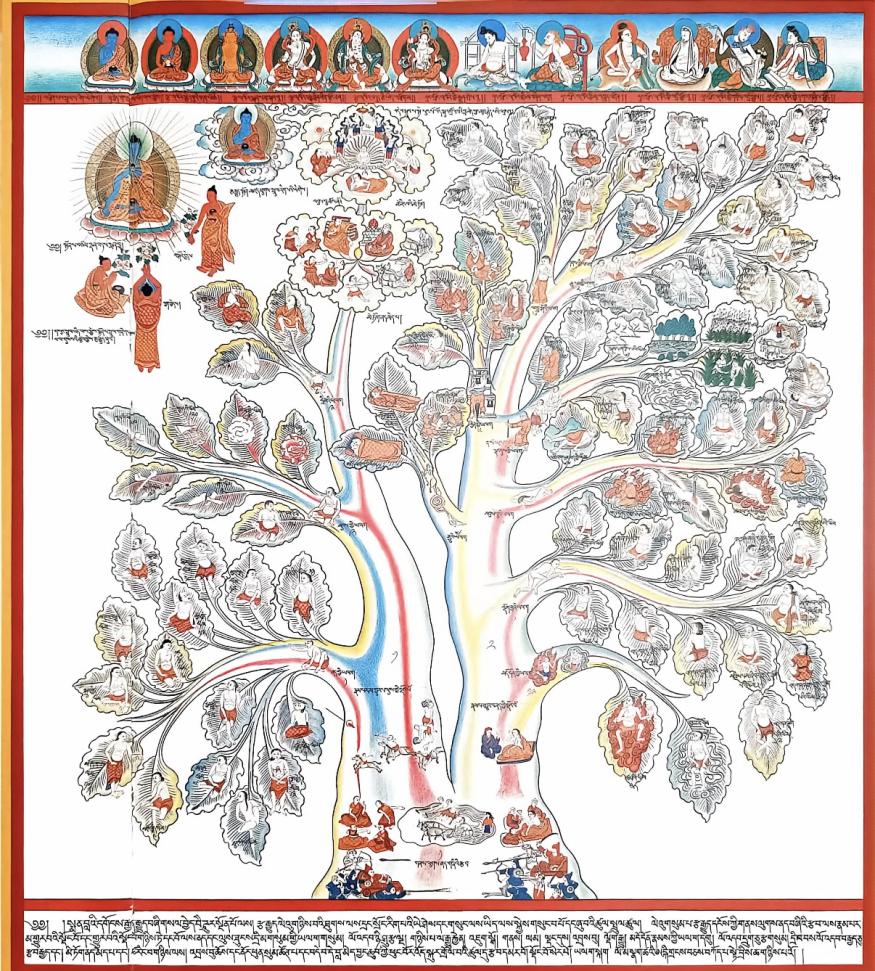
The Four Tantras medical thangkas — Tree of Health & Disease
Claim ②:
Yellow represents the Earth element;
White represents the Water element;
Red represents the Fire element;
Green represents the Wind element;
Blue represents the Space element.
Claim ①:
White represents Bad-kan, the body's "Water" system;
Yellow represents mKhris-pa, the body's "Fire" system;
Blue represents rLung, the body's "Wind" system.
Sichuan School Tibetan Medicine
Comparison
| Northern School | Southern School | |
|---|---|---|
| Geographic range | Cold, dry highland northwest of Lhasa | Southeast of Lhasa and Kham region (Sichuan, Yunnan, eastern Tibet, Qinghai) |
| Key figures | Jangpa Namgyal Drakpa | Zurkhang Nyamnyi Dorje |
| Core strength | Theory, physiology and pathology | Practice, pharmacology |
| Prescribing style | Prefers warming drugs; formulas often have many ingredients | Prefers cooling drugs; formulas often have fewer ingredients |
| Therapeutic specialty | Moxibustion | Plant identification, bloodletting, compounding, and processing |
| Contribution | Drew early medical charts; laid base for Manthang | Recovered original Four Tantras; printed Zatang edition |
Sichuan-school Tibetan Medicine
The "Sichuan School" usually refers to the Southern School, as its center is in the Kham region of Sichuan.
- Geographic center: Ganzi Prefecture in Sichuan is the homeland and birthplace of the Southern School; Dege County is known as the "birthplace of Southern Tibetan medicine".
- Theoretical foundation: The foundational framework was established by Zurkhang Nyamnyi Dorje in the 12th–15th centuries.
- Diagnostic and therapeutic features: Specializes in the three diagnostic methods: observation, inquiry, and pulse-taking. Mainly treats digestive disorders (Phlegm/Bekan diseases), high-altitude rheumatism, and hypertension.
- Prescribing style: Uses multi-ingredient compound formulas, cooling herbs, and bloodletting therapy.
- Cultural status: Inscribed on China's national intangible cultural heritage list in 2006.